
6 posts tagged with "Automation"

Leveraging tools and practices to automate tasks and pipelines.

View All Tags

AI Is Not Failing. Your Execution Is.

· 6 min read
Shubham Narkhede
DevOps Engineer @ Robert Bosch GmbH

Everyone is talking about AI replacing jobs.

Few people are talking about what happens when companies deploy AI faster than their own systems can actually support it.

That is the real story of 2026.

Over the past year, enterprises across every industry pushed AI adoption with one goal in mind: cut costs, move fast, and automate as aggressively as possible. Executives wanted AI roadmaps. Investors wanted AI narratives. Employees wanted AI tools integrated into daily workflows immediately. And so, organizations that spent years struggling with digital transformation started trying to redesign entire operational systems around generative AI in just a few months.

The pressure was real. The excitement made sense.

But the industry is now entering a second phase of AI adoption, and this phase is exposing something most companies seriously underestimated.
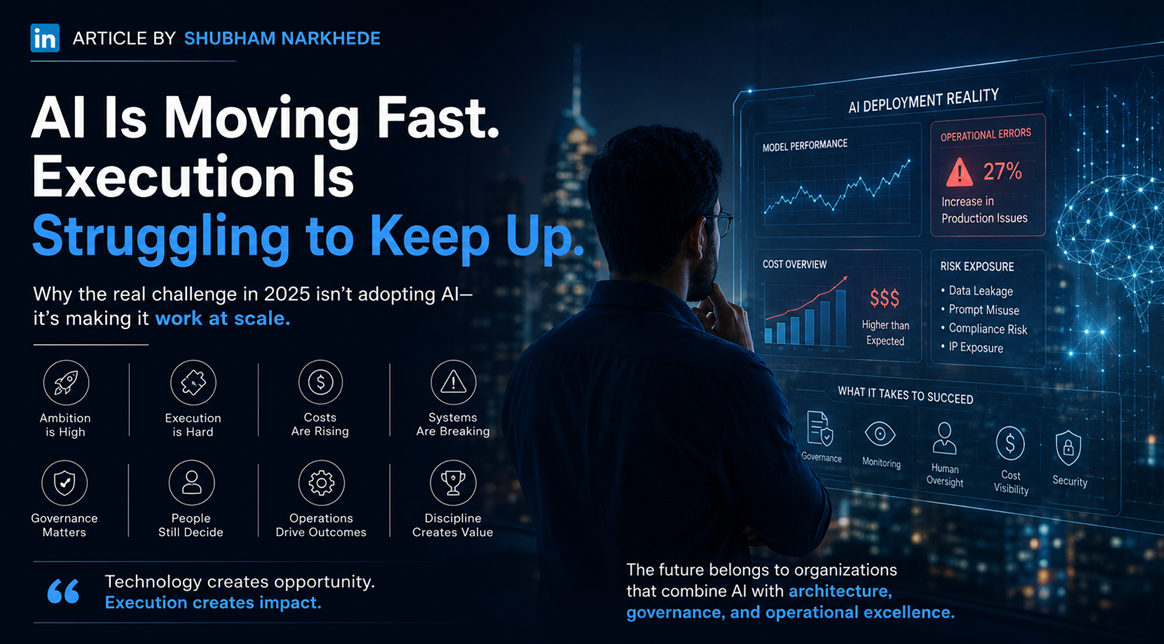
AI Industry Banner

The gap between AI ambition and operational readiness is showing up as real damage.

Companies are deploying models faster than they can govern them. Employees are using AI tools faster than leadership teams can approve them. And the numbers reflect this clearly.

Only about one in four AI initiatives actually deliver their expected ROI. Fewer than 20 percent have been fully scaled across the enterprise. Nearly half of organizations using generative AI have already run into problems, ranging from hallucinated outputs to cybersecurity incidents, privacy exposure, and IP leakage.

The biggest misconception in the AI race is simple: intelligence does not automatically equal reliability.

A model generating impressive outputs in a sandbox does not mean it will operate reliably inside a real business system. Real enterprise environments are not controlled demos. They are messy, unpredictable, and full of edge cases that no demo ever reveals.

Real businesses operate through:

  • Legacy infrastructure that was never designed with AI in mind
  • Fragmented workflows across disconnected teams and systems
  • Compliance requirements that vary by region, industry, and contract
  • Unpredictable human behavior that no simulation accounts for
  • Inconsistent data pipelines feeding inaccurate information into models
  • Operational exceptions that break automation logic daily
  • Security vulnerabilities introduced the moment AI touches production systems
  • Constantly changing business rules that models have no awareness of

The real-world failures are not theoretical. They are already happening.

Finance teams did not anticipate how token-based pricing scales compared to traditional SaaS software costs. The more employees interact with models, the more workflows become AI-dependent, the more automation layers get added, and the harder cost visibility becomes. What looked affordable during pilot testing became a financial operations problem at enterprise scale.

Retail and logistics companies deployed AI-powered automation systems and ran into operational failures they never saw coming: incorrect discounts, inventory mismatches, mislabeling issues, broken fulfillment logic, and workflow conflicts between automated systems and human operations.

Logistics optimization engines performed perfectly in simulations. Then they failed when exposed to unpredictable delivery behavior, regional constraints, human delays, weather conditions, and real-world variables that no simulation modeled accurately.

And even the largest, most well-resourced companies in the world faced this. Walmart, mid-2025, had to completely reshape its agentic AI approach, moving away from multiple disconnected single-purpose agents toward a unified framework, because orchestrating dozens of agents created more operational fragmentation than efficiency.

The issue was never whether the model was intelligent. The issue was whether the surrounding system was mature enough to support it.
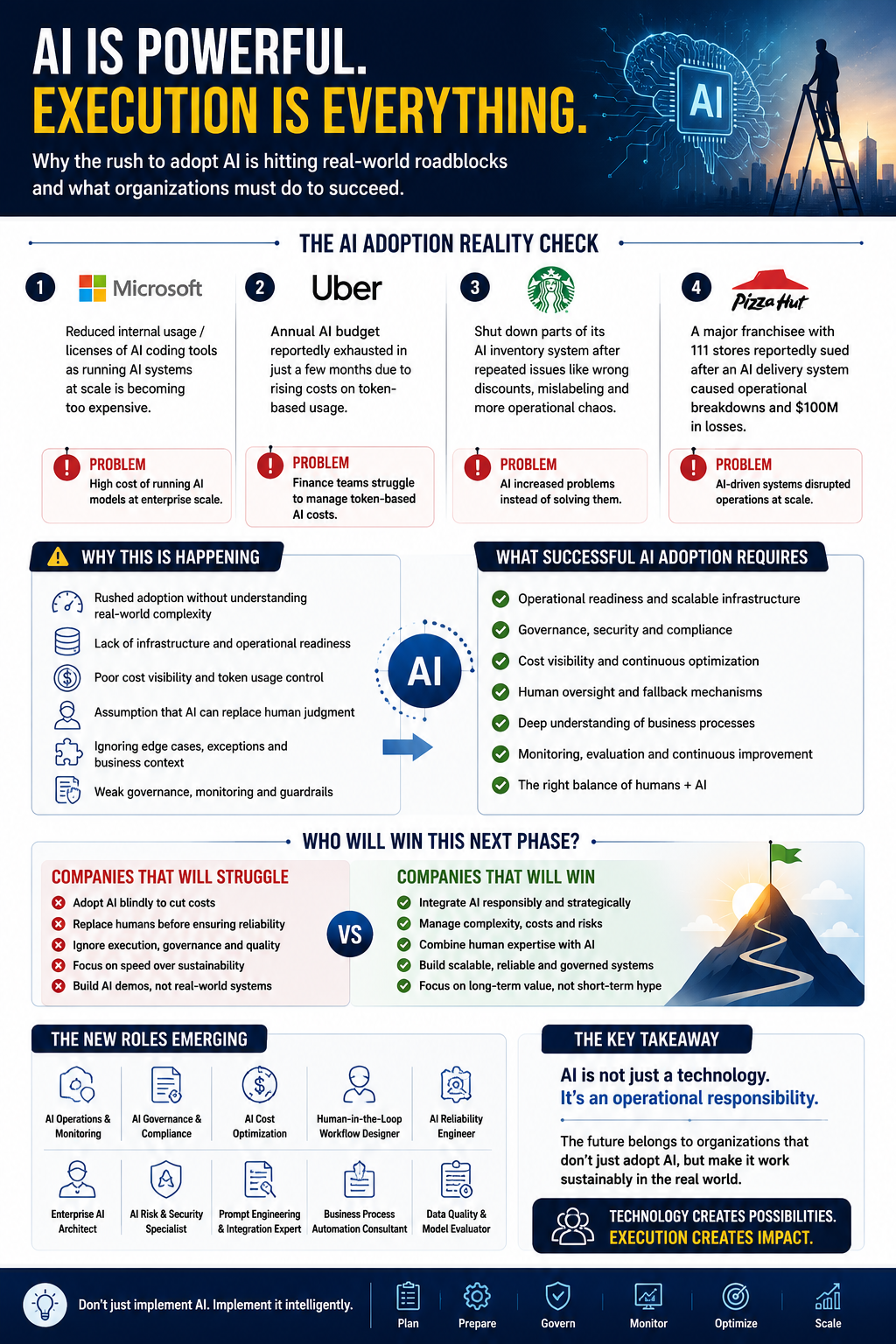
Understanding the Operational Need of AI in Industry

Sustainable AI adoption requires far more than plugging a model into your organization.

It requires:

  • Operational readiness established before deployment, not after
  • Governance frameworks that match your actual risk profile
  • Monitoring systems that catch failures before customers do
  • Infrastructure built for scale, not for pilots
  • Cost visibility so finance teams are not blindsided mid-quarter
  • Human oversight at every decision point that carries real consequence
  • Fallback mechanisms for when the model gets it wrong
  • Security controls that cover your actual exposure surface, not a theoretical one
  • Deep understanding of your specific business processes and where AI breaks them

This work is not glamorous. It does not generate viral demos or impressive press releases. But it is the difference between experimentation and sustainable adoption.

The internal risk conversation is still massively underestimated.

The riskiest AI behaviors in 2025 are not external threats. They are internal.

Employees are already uploading sensitive files into public AI tools. Teams are using unauthorized AI applications that sit entirely outside governance policies. Confidential prompts are leaking intellectual property. AI-generated outputs are introducing hallucinated information into real business workflows.

Most of this is not malicious. It is employees trying to work faster and stay productive. But speed without governance creates exposure. And many organizations were completely unprepared for how fast shadow AI usage would spread internally once employees realized how powerful these tools could be.

Between 2023 and 2024, the amount of corporate data being uploaded into AI tools rose by 485 percent. From 2024 to 2025, employee data flowing into generative AI services grew more than 30 times. That is not a slow, manageable shift. That is an exposure surface expanding faster than most security teams can track.

The conversation in the industry is shifting. And it is shifting in an important direction.

Not from "AI will replace everyone" to "AI is failing."

It is shifting from "How fast can we adopt AI?" to "How do we make AI work reliably at scale?"

That shift is already creating entirely new categories of technical work that barely existed two years ago:

  • AI operations and monitoring
  • AI governance and compliance
  • AI reliability engineering
  • AI cost optimization
  • AI security and auditing
  • Enterprise AI architecture
  • Human-in-the-loop workflow design
  • AI infrastructure optimization
  • Business-process-aware automation consulting

Ironically, while most people debate whether AI will eliminate jobs, AI is simultaneously creating entirely new technical disciplines. The market is not simply replacing expertise. It is redefining where expertise matters most.

Preparation beats speed. Every time.

The UAE invested in AI infrastructure and governance starting in 2017, five years before generative AI entered the mainstream. By 2025, AI trust there registered around 67 percent, compared to 32 percent in the US. That gap did not come from better models. It came from better preparation and longer institutional commitment to getting the foundations right before scaling fast.

I work at the intersection of full-stack engineering, DevOps, and system architecture. From this position, one thing is clear.

The organizations that will come out ahead are not the ones moving fastest. They are the ones combining technical execution with operational discipline. They are treating AI the way experienced engineers treat infrastructure: with monitoring, fallback mechanisms, governance layers, observability, and deep integration into actual business context.

The Three Waves of AI

The first wave of AI was about possibility.

The second wave is about sustainability.

The third wave will be about operational maturity.

The winners will not be the companies with the loudest AI announcements or the fastest deployment timelines.

They will be the companies with the strongest execution.

Speed gets you to production. Discipline keeps you there.

GitHub Copilot: My AI Coding Companion - From Code Completion to Architecture

· 8 min read
Shubham Narkhede
DevOps Engineer @ Robert Bosch GmbH

The First Time I Used GitHub Copilot

I remember the first time I used GitHub Copilot. I was writing a Python function to parse JSON data, and as I started typing the function signature, Copilot suggested the entire implementation. I was skeptical. I thought it would be wrong or incomplete. I pressed Tab to accept the suggestion, and it was perfect.

That moment changed how I think about coding. I realized that AI could significantly accelerate the coding process by handling routine, repetitive tasks. Over the past two years, GitHub Copilot has become an indispensable part of my coding workflow.

What is GitHub Copilot?

GitHub Copilot is an AI-powered code completion tool developed by GitHub and OpenAI. It's built on top of OpenAI's Codex model and is trained on billions of lines of code from public repositories on GitHub. The tool integrates directly into your code editor (VS Code, JetBrains IDEs, Neovim, etc.) and provides real-time code suggestions.

The key insight behind Copilot is that much of the code we write follows patterns. We write similar functions, similar loops, similar error handling. By learning these patterns from billions of lines of code, Copilot can predict what you're trying to write and suggest completions.

How I Use GitHub Copilot

My use of Copilot has evolved significantly over time. Initially, I used it primarily for simple code completions. Now, I use it for much more complex tasks:

Boilerplate Code: When I start a new file, Copilot can generate the initial structure. For example, when I start a new React component, Copilot can generate the basic component structure with hooks and state management.

Function Implementation: When I write a function signature, Copilot can often generate the entire implementation. This is particularly useful for utility functions and data processing functions.

Tests and Documentation: Copilot can generate test cases and documentation based on the code. This has been incredibly helpful for maintaining comprehensive test coverage.

Refactoring: When I need to refactor code, Copilot can suggest improved implementations. This is particularly useful for performance optimizations.

Bug Fixes: When I have a bug, Copilot can often suggest fixes based on the error message and surrounding code.

Architecture and Design: For more complex tasks, I can use Copilot Chat (the conversational interface) to discuss architectural decisions and design patterns.

The Productivity Impact

The productivity impact of GitHub Copilot has been significant. I estimate that Copilot has increased my coding productivity by 30-40%. Here's why:

Reduced Typing: Copilot reduces the amount of typing required. Instead of typing out entire functions, I can accept Copilot's suggestions with a single keystroke.

Reduced Mental Load: By handling routine code generation, Copilot frees up mental capacity for more complex problems. I can focus on architecture and logic instead of syntax and boilerplate.

Faster Prototyping: When prototyping new features, Copilot allows me to quickly generate working code that I can then refine.

Better Code Quality: Copilot often suggests best practices and patterns that I might not have thought of. This has improved the overall quality of my code.

Learning: By seeing how Copilot implements functions, I've learned new patterns and best practices.

The Limitations and Challenges

While Copilot is incredibly powerful, it has limitations:

Hallucinations: Copilot sometimes generates code that looks correct but is actually wrong. This is particularly true for complex algorithms or domain-specific code.

Context Limitations: Copilot has a limited context window. For very large files or complex projects, Copilot might not have enough context to generate accurate suggestions.

Outdated Patterns: Copilot is trained on historical code, so it sometimes suggests outdated patterns or libraries.

Security Concerns: There have been concerns about Copilot generating code that might have security vulnerabilities or that might be similar to existing code in ways that raise copyright questions.

Language Limitations: Copilot works better for some languages than others. It's excellent for Python, JavaScript, and Java, but less reliable for niche languages.

Best Practices for Using Copilot

Over time, I've developed best practices for using Copilot effectively:

Review All Suggestions: Never blindly accept Copilot's suggestions. Always review the code to ensure it's correct and follows your project's conventions.

Use Clear Naming: Copilot works better when variable names and function names are clear and descriptive. This provides better context for the AI.

Provide Context: Write clear comments explaining what you're trying to do. Copilot uses these comments to generate better suggestions.

Use Copilot Chat for Complex Tasks: For complex tasks, use Copilot Chat to have a conversation with the AI. This often produces better results than simple code completion.

Combine with Other Tools: Use Copilot in combination with linters, type checkers, and tests. These tools help catch errors that Copilot might introduce.

Understand the Limitations: Understand that Copilot is a tool, not a replacement for human judgment. For critical code, always do thorough reviews.

Copilot for Different Languages

My experience with Copilot varies by language:

Python: Copilot is excellent for Python. It understands Python idioms well and generates high-quality suggestions. I use it extensively for data processing and utility functions.

JavaScript/TypeScript: Copilot is very good for JavaScript and TypeScript. It understands React patterns, async/await, and modern JavaScript features.

Go: Copilot is quite good for Go. It understands Go idioms and generates clean, idiomatic code.

SQL: Copilot can generate SQL queries, but I'm more cautious here. SQL queries are often domain-specific, and Copilot sometimes generates suboptimal queries.

Infrastructure as Code (Terraform, CloudFormation): Copilot is good for IaC. It understands common patterns and can generate boilerplate configurations.

Copilot Chat: The Conversational Interface

Beyond simple code completion, GitHub Copilot Chat has been transformative. This is a conversational interface where I can ask Copilot questions about my code:

Explaining Code: I can ask Copilot to explain what a piece of code does. This is useful when working with unfamiliar code.

Generating Tests: I can ask Copilot to generate test cases for a function. This has significantly improved my test coverage.

Refactoring: I can ask Copilot to refactor code for performance or readability.

Debugging: I can ask Copilot to help debug issues. By providing the error message and relevant code, Copilot can often suggest fixes.

Architecture Discussions: I can have conversations about architectural decisions and design patterns.

The Cost-Benefit Analysis

GitHub Copilot costs $10/month for individual developers or $19/month for business users. Is it worth it?

For me, absolutely. The time savings alone justify the cost. If Copilot saves me even one hour per week (which it easily does), that's worth far more than $10/month. Beyond time savings, the improved code quality and learning opportunities provide additional value.

For teams, the business case is even stronger. A team of 10 developers using Copilot could save hundreds of hours per month, which translates to significant cost savings.

The Future of Copilot

GitHub Copilot is constantly evolving. Recent improvements include:

Better Context Understanding: Copilot now has better understanding of project context, allowing it to generate more relevant suggestions.

Improved Accuracy: The underlying models are improving, leading to fewer hallucinations and better code quality.

Expanded Language Support: Support for more languages is being added.

Integration with More Tools: Copilot is being integrated into more IDEs and tools.

Enterprise Features: GitHub is adding enterprise features like code review integration and security scanning.

My Workflow with Copilot

Here's how I typically use Copilot in my daily workflow:

  1. Start with a Clear Function Signature: I write a clear function signature with descriptive names.

  2. Add Comments: I add comments explaining what the function should do.

  3. Let Copilot Suggest: I let Copilot suggest the implementation.

  4. Review and Refine: I review the suggestion, make any necessary changes, and refine as needed.

  5. Test: I write tests to verify the implementation is correct.

  6. Iterate: If tests fail, I use Copilot Chat to debug and refine.

This workflow has become second nature, and I find myself much more productive than before.

Ethical Considerations

As I use Copilot more, I've become more aware of ethical considerations:

Copyright and Attribution: Some of the code Copilot generates might be similar to existing code in its training data. I'm mindful of this and ensure I'm not inadvertently copying code.

Security: I'm careful to review Copilot's suggestions for security vulnerabilities.

Bias: Like all AI models, Copilot might have biases. I'm aware of this and try to catch biased suggestions.

Responsible Use: I use Copilot responsibly, not as a replacement for thinking, but as a tool to augment my capabilities.

Conclusion

GitHub Copilot has transformed how I code. It's made me more productive, helped me write better code, and allowed me to focus on more complex problems. While it has limitations, the benefits far outweigh the drawbacks.

If you're a developer and haven't tried GitHub Copilot yet, I highly recommend it. Start with a free trial and see how it fits into your workflow. I'm confident you'll find it valuable.


Key Takeaways

  • GitHub Copilot is an AI-powered code completion tool that significantly increases coding productivity
  • It's useful for boilerplate code, function implementation, tests, documentation, and refactoring
  • Productivity improvements of 30-40% are achievable with proper usage
  • Always review Copilot's suggestions and understand its limitations
  • Copilot Chat is useful for complex tasks like refactoring, debugging, and architecture discussions
  • The cost-benefit analysis strongly favors using Copilot
  • Ethical considerations around copyright, security, and bias are important

Mastering Generative AI: From Daily Productivity to Strategic Decision-Making

· 9 min read
Shubham Narkhede
DevOps Engineer @ Robert Bosch GmbH

The AI Revolution in My Daily Life

Two years ago, I viewed Generative AI as a fascinating technology that would eventually transform work. Today, I can't imagine working without it. Generative AI has become as essential to my workflow as email or Slack. It's not just a tool I use occasionally; it's woven into nearly every aspect of my professional and personal life.

This transformation didn't happen overnight. It required deliberate learning, experimentation, and a willingness to adapt my workflows. More importantly, it required understanding that mastering AI isn't about knowing how to use one tool—it's about understanding the landscape of AI capabilities and knowing which tool to use for which task.

In this blog series, I'm sharing my journey of mastering Generative AI. I'll explore the specific tools I use, the use cases I've developed, the certifications I've pursued, and the lessons I've learned. My hope is that this series will help others accelerate their own AI mastery journey.

What Does "Mastering" Generative AI Mean?

Before diving into specifics, let me define what I mean by mastering Generative AI. It's not about being an AI researcher or understanding the mathematical foundations of transformer models. Instead, it's about:

Strategic Tool Selection: Understanding the strengths and weaknesses of different AI models and knowing which tool to use for which task. GitHub Copilot for coding, Claude for complex reasoning, Gemini for research, etc.

Workflow Integration: Embedding AI into existing workflows so seamlessly that it becomes invisible. Instead of thinking "I need to use AI for this," it's just part of how I work.

Prompt Engineering Mastery: Understanding how to craft prompts that elicit the best responses from AI models. This goes beyond simple prompts to understanding model capabilities and limitations.

Continuous Learning: Staying updated with new models, new capabilities, and new use cases. The AI landscape is evolving rapidly, and what worked six months ago might be outdated today.

Ethical and Responsible Use: Understanding the limitations and potential harms of AI, and using it responsibly. This includes understanding bias, hallucinations, and privacy implications.

The Landscape of Generative AI Tools

The first step in mastering Generative AI is understanding the landscape. There are dozens of AI tools available, each with different strengths:

Large Language Models (LLMs): Claude (Opus, Sonnet, Haiku), GPT-4, Gemini Pro, Llama 2, Mistral. These are general-purpose models that can handle a wide range of tasks.

Code-Specific Tools: GitHub Copilot, Tabnine, Codeium. These are optimized for code generation and completion.

Specialized Tools: Midjourney and DALL-E for image generation, Eleven Labs for voice synthesis, Runway for video generation.

Workflow Automation: n8n, Make (formerly Zapier), Automation Anywhere. These allow you to build complex workflows that leverage AI.

Enterprise Solutions: OpenAI's API, Anthropic's API, Google Cloud AI, Azure OpenAI. These provide enterprise-grade access to AI capabilities.

Understanding this landscape is crucial. You can't master all tools, but you can understand which tools are best suited for which tasks.

My AI Mastery Journey

My journey with Generative AI began in early 2023, shortly after ChatGPT's public release. Like many people, I was initially skeptical. I thought it was a novelty that would eventually fade. I was wrong.

In mid-2023, I started experimenting with AI for coding tasks. GitHub Copilot was a game-changer. It could generate code snippets, complete functions, and even suggest entire implementations. I realized that AI could significantly accelerate my coding productivity.

From there, I started exploring other use cases. I used Claude for complex reasoning tasks. I used Gemini for research. I used n8n to build workflows that automated repetitive tasks. Gradually, AI became integrated into nearly every aspect of my work.

By late 2024, I had developed a comprehensive AI-powered workflow. I use AI for:

  • Coding: GitHub Copilot for code generation, Claude for architectural decisions
  • Documentation: Claude for writing documentation, GitHub Copilot for code examples
  • Marketing: Claude for content creation, Gemini for research
  • Project Management: Claude for planning, Gemini for analysis
  • Personal Productivity: Claude for writing, Gemini for research, n8n for automation

This integration has made me significantly more productive. I estimate that AI has increased my productivity by 30-40% across various tasks.

The Skills Required

Mastering Generative AI requires developing several key skills:

Prompt Engineering: This is the most critical skill. Understanding how to craft prompts that elicit the best responses from AI models is crucial. This includes understanding model capabilities, limitations, and quirks.

Critical Evaluation: AI models are powerful, but they're not perfect. They can hallucinate, make mistakes, and produce biased outputs. Developing the ability to critically evaluate AI outputs is essential.

Workflow Design: Understanding how to integrate AI into existing workflows requires thinking about process design. How can AI be inserted into a workflow to maximize value?

Continuous Learning: The AI landscape is evolving rapidly. Staying updated with new models, new capabilities, and new use cases requires continuous learning.

Ethical Reasoning: Understanding the ethical implications of AI use is crucial. This includes understanding bias, privacy, and responsible AI practices.

The Certifications and Learning Path

To deepen my understanding of Generative AI, I've pursued several certifications:

LinkedIn Learning: Completed courses on Generative AI fundamentals, prompt engineering, and AI in business.

Coursera: Completed Google's Generative AI for Everyone course and DeepLearning.AI's short courses on prompt engineering.

Google Cloud: Completed Google Cloud's Generative AI fundamentals course.

Microsoft: Completed Microsoft's AI fundamentals course.

Anthropic: Studied Anthropic's documentation and best practices for using Claude.

These certifications have provided structured learning and helped me understand the fundamentals of Generative AI. However, the real learning has come from hands-on experimentation and applying AI to real-world problems.

The Business Impact

The integration of Generative AI into my workflow has had significant business impact:

Increased Productivity: I estimate that AI has increased my productivity by 30-40% across various tasks. Tasks that previously took hours now take minutes.

Improved Quality: AI has helped me produce higher-quality work. For example, AI-generated documentation is often more comprehensive and better organized than what I would have written manually.

Faster Decision-Making: AI has enabled faster decision-making by providing quick analysis and insights on complex problems.

New Capabilities: AI has enabled me to take on tasks that I previously couldn't do efficiently. For example, I can now generate marketing content quickly, which was previously a bottleneck.

Cost Reduction: By automating repetitive tasks with n8n and AI, I've reduced the time spent on manual work, freeing up time for higher-value activities.

The Challenges and Lessons Learned

Mastering Generative AI hasn't been without challenges:

Over-reliance on AI: Early on, I was tempted to rely too heavily on AI. I learned that AI is a tool to augment human capability, not replace it. Critical thinking and human judgment are still essential.

Quality Variability: AI outputs are variable. Sometimes they're excellent, sometimes they're mediocre. Learning to recognize quality variations and knowing when to accept or reject AI outputs is crucial.

Prompt Optimization: Crafting the perfect prompt requires iteration. What works for one task might not work for another. Learning to optimize prompts through trial and error is a key skill.

Keeping Up with Changes: The AI landscape is evolving rapidly. New models are released frequently, and existing models are updated. Staying current requires continuous learning.

Ethical Concerns: As I've used AI more, I've become more aware of ethical concerns around bias, privacy, and responsible AI. Learning to navigate these concerns is important.

Looking Ahead

As I look toward the future, I see several trends:

Multimodal AI: AI models that can handle text, images, audio, and video will become more prevalent. This will enable new use cases and workflows.

Specialized Models: We'll see more specialized models optimized for specific tasks. General-purpose models will still be important, but specialized models will provide better performance for specific use cases.

AI Integration: AI will become more integrated into existing tools and workflows. Instead of using separate AI tools, AI capabilities will be built into tools like Slack, Jira, Outlook, etc.

Regulatory Framework: As AI becomes more prevalent, regulatory frameworks will emerge. Understanding and complying with these frameworks will become important.

Ethical AI: There will be increased focus on ethical AI practices. Organizations that prioritize responsible AI will have a competitive advantage.

The Structure of This Series

This blog series is organized into several parts:

Part 1: AI Tools - Deep dives into specific AI tools I use (GitHub Copilot, Claude Opus/Sonnet, Gemini, etc.) and how I use them.

Part 2: Use Cases - Specific use cases where I've integrated AI into my workflow (coding, documentation, marketing, project management, etc.).

Part 3: Certifications and Skills - My learning journey, certifications pursued, and skills developed.

Part 4: Project Management and Product Management - How I've integrated AI into project management and product management workflows.

Part 5: Lessons and Future - Key lessons learned and thoughts on the future of AI.

Each part will have multiple posts diving deep into specific topics.

Conclusion

Mastering Generative AI is not a destination; it's a journey. It requires continuous learning, experimentation, and adaptation. But the rewards are significant. AI has transformed how I work, making me more productive, more creative, and more capable.

My hope is that this blog series will help you accelerate your own AI mastery journey. Whether you're just starting to explore AI or you're already using it extensively, I believe there's value in understanding how others are integrating AI into their workflows.

The future of work will be shaped by those who can effectively leverage AI. The time to start mastering Generative AI is now.


Key Takeaways

  • Mastering Generative AI is about strategic tool selection, workflow integration, and continuous learning
  • The AI landscape includes LLMs, code-specific tools, specialized tools, and workflow automation platforms
  • Prompt engineering, critical evaluation, and ethical reasoning are essential skills
  • Certifications and hands-on experimentation are both important for learning
  • AI has increased productivity by 30-40% and enabled new capabilities
  • The future will see more specialized models, better integration, and increased focus on ethical AI

2025: The Year of AI-Driven Automation in Enterprise

· 8 min read
Shubham Narkhede
DevOps Engineer @ Robert Bosch GmbH

The Inflection Point

2024 was the year of foundation-building. We containerized applications, standardized infrastructure, and established the plumbing for modern enterprise operations. 2025 is different. It's the year when AI moves from experimental projects to production systems that directly impact business outcomes.

At Bosch, this shift is palpable. The conversations have changed. It's no longer "Should we invest in AI?" but rather "How do we scale AI across the organization?" The question isn't theoretical; it's urgent. The automotive industry's contraction has intensified the need for efficiency, and AI is the lever that enables it.

The Convergence

Three trends are converging in 2025:

First: The infrastructure we built in 2024 is now mature enough to support AI workloads at scale. Kubernetes clusters are stable, CI/CD pipelines are reliable, and observability is comprehensive.

Second: AI models have become more practical and accessible. Open-source models like Llama, Mistral, and others have democratized access to powerful AI capabilities. You no longer need to build models from scratch; you can fine-tune existing models for your specific use cases.

Third: The business imperative is clear. In a contracting market, companies that can automate routine tasks, optimize processes, and make faster decisions will outcompete those that can't. AI is the technology that enables this.

The Automation Wave

In 2025, we're seeing automation expand into areas that were previously considered too complex or too human-centric:

Document Understanding and Processing

Bosch processes millions of documents annually—invoices, contracts, technical specifications, regulatory filings. Historically, this required human review and manual data entry. In 2025, we've deployed AI models that can:

  • Extract structured data from unstructured documents with 95%+ accuracy
  • Classify documents automatically and route them to appropriate departments
  • Identify anomalies and flag documents that require human review
  • Learn from corrections when humans review flagged documents, continuously improving accuracy

The impact is dramatic. A process that previously took days now takes hours. The 5% of documents that require human review are handled by experts who can focus on complex edge cases rather than routine processing.

Predictive Analytics and Forecasting

Supply chain forecasting is notoriously difficult. Demand fluctuates based on market conditions, consumer preferences, and external shocks. In 2025, we've deployed ensemble models that combine multiple forecasting approaches:

  • Time series models that capture seasonal patterns and trends
  • Causal models that incorporate external factors like economic indicators and competitor actions
  • Anomaly detection that identifies unusual patterns that might indicate structural changes

These models are integrated into the supply chain planning system. When a model predicts a potential shortage, the system automatically triggers procurement workflows and notifies stakeholders. When demand is forecast to be lower than expected, the system recommends production adjustments.

The result: 20-25% improvement in forecast accuracy, leading to better inventory management and reduced stockouts.

Intelligent Routing and Scheduling

Bosch operates a complex network of manufacturing facilities, distribution centers, and service centers. Routing products and service technicians efficiently is a complex optimization problem. In 2025, we've deployed AI models that:

  • Optimize routing for delivery vehicles based on real-time traffic data, delivery windows, and vehicle capacity
  • Schedule service technicians based on skill requirements, location, and availability
  • Predict demand for service appointments and recommend staffing levels

These optimizations have reduced delivery times by 15% and improved service technician utilization by 20%.

Customer Service and Support

Bosch's customer support teams handle thousands of inquiries daily. In 2025, we've deployed conversational AI systems that:

  • Answer common questions using a knowledge base of FAQs and technical documentation
  • Route complex issues to appropriate support specialists
  • Provide proactive support by analyzing customer usage patterns and recommending solutions before issues occur

The system handles 60% of inquiries without human intervention, freeing support specialists to focus on complex technical issues.

The Technology Stack Evolution

The technology stack we use for AI in 2025 has evolved:

Model Development: We use a mix of open-source frameworks (PyTorch, TensorFlow) and cloud-based services (AWS SageMaker, Azure ML). For large language models, we use open-source models like Llama 2 and Mistral, fine-tuned on Bosch-specific data.

Model Serving: We've moved beyond simple REST APIs to more sophisticated serving infrastructure. We use KServe (running on Kubernetes) for model serving, which provides features like auto-scaling, canary deployments, and A/B testing.

Data Pipelines: We've invested in data infrastructure that can handle the volume and variety of data required for AI. We use Apache Spark for batch processing and Kafka for streaming data. Data is stored in data lakes (S3, Azure Data Lake) and data warehouses (Snowflake, BigQuery).

Monitoring and Governance: We've implemented comprehensive monitoring for AI models, including:

  • Model performance monitoring: Tracking metrics like accuracy, precision, recall, and F1 score
  • Data drift detection: Identifying when the distribution of input data changes, which can degrade model performance
  • Model drift detection: Identifying when model predictions change unexpectedly
  • Fairness and bias monitoring: Ensuring that models don't discriminate against protected groups

Governance Framework: We've established a governance framework for AI that includes:

  • Model registry: Tracking all models in production, their versions, and their performance
  • Approval workflows: Requiring human review before models are deployed to production
  • Audit trails: Logging all decisions made by AI systems for regulatory compliance
  • Explainability: Ensuring that AI recommendations can be explained to stakeholders

The Human Element: Reskilling and Adaptation

The expansion of AI automation has significant implications for the workforce. At Bosch, we've been proactive about addressing this:

Reskilling Programs: We've launched programs to help employees transition from routine tasks to higher-value work. For example, invoice processors are being trained to handle complex, anomalous invoices that require judgment and expertise.

New Roles: We've created new roles that didn't exist before—AI trainers who help models learn from human feedback, AI auditors who ensure models are fair and compliant, and AI product managers who oversee the development and deployment of AI systems.

Change Management: We've invested in communication and change management to help employees understand how AI will impact their work and how the company is supporting them through the transition.

The reality is that some roles will be eliminated or significantly reduced. But new roles are being created, and employees who are willing to learn and adapt are finding opportunities.

Project Transitions and Ramp-Downs

As AI automation expands, some projects are being transitioned or ramped down:

The Connected Charging Cable Project: This project, which aimed to create a unified charging ecosystem for electric vehicles, is being transitioned to maintenance mode. The team that built it is being redistributed to AI and automation initiatives.

The Charge Point Management System: This system is being sunset in favor of a cloud-native replacement that incorporates AI-driven optimization for charging networks.

Legacy Support Systems: Several legacy support systems are being replaced by AI-driven alternatives that provide better user experience and lower operational costs.

These transitions are not failures. They're evidence of the organization's ability to adapt and prioritize resources based on changing business needs.

The Business Impact

The expansion of AI automation in 2025 is delivering significant business value:

Cost Reduction: Automation of routine tasks has reduced operational costs by 15-20% in affected areas.

Speed Improvement: Processes that previously took days now take hours. This enables faster decision-making and faster time-to-market for new products and services.

Quality Improvement: AI-driven quality control and anomaly detection have reduced defects and improved customer satisfaction.

Competitive Advantage: In a contracting market, the ability to operate more efficiently is a significant competitive advantage.

Employee Satisfaction: By automating routine tasks, employees can focus on more meaningful work, which improves job satisfaction.

Challenges and Lessons

The expansion of AI automation hasn't been without challenges:

Data Quality: Many of Bosch's data sources have quality issues. We've had to invest significant effort in data cleaning and standardization.

Model Bias: Some models have exhibited bias in their predictions. We've had to implement fairness checks and rebalance training data.

Change Resistance: Not all employees have embraced AI automation. Some see it as a threat to their job security. We've had to invest in communication and change management.

Regulatory Uncertainty: As AI systems make decisions that affect people, regulatory frameworks are evolving. We've had to build governance frameworks that anticipate future regulations.

Looking Ahead to 2026

As we look toward 2026, several trends are emerging:

Generative AI Integration: Large language models will be more deeply integrated into business processes. We'll see AI-generated content for marketing, customer service, and technical documentation.

Edge AI: AI models will be deployed on edge devices, enabling real-time decision-making without relying on centralized servers.

Autonomous Systems: More business processes will become fully autonomous, with AI systems making decisions without human intervention.

Ethical AI: As AI systems become more prevalent, there will be increased focus on ethical considerations—fairness, transparency, and accountability.


Key Takeaways

  • 2025 is the year when AI moves from experimental projects to production systems
  • AI automation is expanding into areas like document processing, forecasting, and customer service
  • The technology stack for AI has evolved to include model serving, data pipelines, and governance frameworks
  • Reskilling and change management are critical for managing the workforce impact of AI automation
  • Business impact includes cost reduction, speed improvement, and competitive advantage

Next month, I'll explore the ethical implications of AI in enterprise environments and how companies like Bosch are building responsible AI systems.

AI at Bosch: The Silent Revolution in Enterprise Automation

· 8 min read
Shubham Narkhede
DevOps Engineer @ Robert Bosch GmbH

The Quiet Transformation

When people talk about AI in 2024, they think of ChatGPT, image generation, and large language models. But inside enterprise organizations like Bosch, the AI revolution is happening in a different form. It's quieter, less visible, but far more consequential: AI powering automation, optimization, and decision-making across thousands of business processes.

I've been observing this transformation firsthand. Over the past year, I've worked on infrastructure that enables AI-driven automation at scale. The shift isn't about replacing humans with robots—it's about augmenting human capability with intelligent systems that can process information, identify patterns, and execute decisions faster and more accurately than manual processes.

The Three Pillars of Enterprise AI at Bosch

First: Predictive Maintenance and Supply Chain Optimization

Bosch manufactures components for millions of vehicles globally. Supply chain disruptions—whether from geopolitical tensions, natural disasters, or market volatility—can cost millions. In 2024, Bosch has deployed AI models that predict component failures before they happen, optimize inventory levels in real-time, and recommend procurement strategies based on demand forecasting.

These aren't cutting-edge research projects. They're production systems handling billions of data points daily. The models are trained on historical manufacturing data, supplier performance metrics, and market signals. When a model predicts a potential shortage of a critical component, the system automatically triggers procurement workflows, notifies supply chain managers, and recommends alternative suppliers.

The impact is measurable: 15-20% reduction in supply chain disruptions, 10-12% improvement in inventory turnover, and significant cost savings. For a company like Bosch with global operations, this translates to hundreds of millions of euros annually.

Second: Intelligent Workflow Automation

Bosch is a company of processes. Thousands of workflows govern everything from hiring to invoicing to quality assurance. Many of these workflows are still partially manual, involving human review and approval at multiple stages.

In 2024, AI is automating these workflows. Document processing systems use optical character recognition (OCR) and natural language processing (NLP) to extract information from invoices, contracts, and technical specifications. Machine learning models classify documents, route them to appropriate departments, and flag anomalies for human review.

For example, the invoice processing workflow that previously required 3-4 manual touchpoints and 2-3 days to complete now processes 85% of invoices automatically within hours. The 15% that require manual intervention are those with unusual characteristics—discrepancies, missing information, or edge cases—which are flagged for human experts.

This isn't just about speed. It's about consistency, accuracy, and freeing human experts to focus on high-value work. The same engineers who previously spent 30% of their time on document processing can now focus on problem-solving and innovation.

Third: Intelligent Monitoring and Anomaly Detection

At Bosch, we operate complex manufacturing facilities, data centers, and IT infrastructure. Monitoring these systems traditionally requires large teams of engineers watching dashboards, responding to alerts, and investigating incidents.

In 2024, AI-powered monitoring systems have transformed this. Machine learning models learn the normal behavior of systems—CPU usage patterns, network traffic, database query performance—and flag deviations that might indicate problems. These systems don't just alert on thresholds; they understand context.

For instance, a spike in database queries at 2 AM might be normal if it's scheduled batch processing, but anomalous if it's occurring outside the expected window. AI models learn these patterns and only alert when there's a genuine anomaly. This reduces false positives by 70-80%, allowing engineers to focus on real issues.

The Technology Stack

What technologies power this transformation? The stack is more pragmatic than cutting-edge:

Machine Learning Frameworks: TensorFlow and PyTorch for model development and training. These frameworks have matured significantly, with extensive documentation and community support.

Data Pipelines: Apache Spark and Kafka for processing massive volumes of data in real-time. At Bosch, we're processing terabytes of data daily—manufacturing sensor data, transaction logs, supply chain metrics.

Model Serving: Kubernetes for orchestrating model inference at scale. A model that's accurate in development is useless if it can't serve predictions in production. Kubernetes enables us to deploy models, scale them based on demand, and ensure high availability.

Monitoring and Observability: Prometheus, Grafana, and ELK stack for monitoring model performance, data drift, and system health. This is critical—a model that performs well initially can degrade over time as data distributions change.

Integration: Custom APIs and middleware to integrate AI systems with existing enterprise applications. Most of Bosch's critical systems were built over decades. AI doesn't replace these systems; it augments them.

The Human Element

Here's what often gets overlooked in discussions of enterprise AI: the human element is crucial. At Bosch, we have data scientists building models, but we also have domain experts—supply chain specialists, manufacturing engineers, quality assurance professionals—who understand the business context.

The most successful AI implementations at Bosch are those where data scientists and domain experts collaborate closely. The data scientist might build a model that predicts component failures with 92% accuracy, but the domain expert understands that in manufacturing, false positives are more costly than false negatives. This insight shapes how the model is deployed and how its predictions are acted upon.

We've also learned that AI systems need human oversight. A model might recommend a procurement strategy that's technically optimal but politically unfeasible or ethically problematic. Humans need to be in the loop, especially for high-stakes decisions.

Challenges and Lessons Learned

The AI transformation at Bosch hasn't been frictionless. We've encountered several challenges:

Data Quality: Many of Bosch's legacy systems have data quality issues—missing values, inconsistent formats, outdated records. Before you can train an AI model, you need to clean and standardize the data. This is unglamorous work, but it's essential.

Change Management: Introducing AI systems means changing how people work. A supply chain manager who previously made procurement decisions based on experience and intuition now needs to work with AI recommendations. This requires training, communication, and patience.

Model Drift: A model trained on 2023 data might not perform well in 2024 if market conditions have changed. We've learned to continuously monitor model performance and retrain models as new data becomes available.

Regulatory and Ethical Concerns: As AI systems make decisions that affect people—hiring, resource allocation, vendor selection—there are regulatory and ethical considerations. Bosch has established governance frameworks to ensure AI systems are transparent, fair, and accountable.

The Business Impact

What's the bottom line? In 2024, AI-driven automation at Bosch is delivering measurable business value:

Operational Efficiency: 20-30% reduction in manual processing time across key workflows. This translates to cost savings and faster decision-making.

Quality Improvement: Anomaly detection systems catch manufacturing defects earlier, reducing rework and warranty costs.

Supply Chain Resilience: Predictive models enable proactive responses to supply chain disruptions, reducing downtime and lost revenue.

Employee Satisfaction: By automating routine tasks, employees can focus on more meaningful work. This improves job satisfaction and reduces turnover.

Competitive Advantage: In a contracting market, companies that can operate more efficiently have a significant advantage. AI-driven automation is a key lever for this efficiency.

Looking Forward

As I look toward 2025 and beyond, I see several trends:

Generative AI Integration: Large language models will be integrated into enterprise systems for document analysis, customer service, and knowledge management. Bosch is already experimenting with LLMs for technical documentation and customer support.

Edge AI: As IoT devices proliferate, there's a shift toward running AI models on edge devices rather than centralized data centers. This enables real-time decision-making and reduces latency.

Autonomous Systems: AI will enable more autonomous systems—manufacturing robots that can adapt to changing conditions, supply chain systems that can self-optimize, IT infrastructure that can self-heal.

AI Governance: As AI systems become more prevalent, governance frameworks will become more sophisticated. Regulatory requirements around transparency, fairness, and accountability will drive how AI is developed and deployed.

A Personal Perspective

Working on AI infrastructure at Bosch has been fascinating. It's easy to get caught up in the hype around AI, but the reality is more nuanced. AI is a tool—a powerful one, but still a tool. The real value comes from understanding the business problem, designing systems thoughtfully, and ensuring that AI augments human capability rather than replacing it.

The automotive industry is in transition. Companies like Bosch are using AI and automation to navigate this transition more effectively. The enterprises that master this will emerge stronger. Those that don't will struggle.


Key Takeaways

  • Enterprise AI at Bosch focuses on automation, optimization, and decision-making rather than cutting-edge research
  • Predictive maintenance, intelligent workflows, and anomaly detection are delivering measurable business value
  • The technology stack is pragmatic, leveraging mature frameworks and tools
  • Human expertise and oversight remain crucial for successful AI implementations
  • Data quality, change management, and model governance are critical challenges
  • AI-driven automation is a key competitive advantage in a contracting market

Next month, I'll dive deeper into the technical architecture of AI systems at scale, exploring how we handle data pipelines, model serving, and monitoring in production environments.

The Future of DevOps: Trends and Predictions for 2024

· 5 min read
Shubham Narkhede
DevOps Engineer @ Robert Bosch GmbH

As we begin 2024, I wanted to share my thoughts on the evolving landscape of DevOps and what trends I believe will shape our industry this year. Drawing from my experiences at Robert Bosch GmbH and observations of the broader technology ecosystem, here are the key developments I'm watching.

1. AI-Augmented DevOps

Perhaps the most significant trend I'm seeing is the integration of AI into DevOps workflows. This goes beyond simple automation to include:

  • Predictive Analysis: AI systems that can anticipate system failures or performance bottlenecks before they occur
  • Intelligent Alerting: Smarter monitoring systems that reduce alert fatigue by contextualizing and prioritizing notifications
  • Automated Code Reviews: AI tools that can suggest optimizations, identify potential bugs, and enforce coding standards
  • Deployment Optimization: ML models that analyze deployment patterns to suggest optimal timing and strategies

At Bosch, we've begun experimenting with AI-powered monitoring for our charging infrastructure systems, and the early results are promising. The ability to predict potential issues before they impact users has already improved our service reliability.

2. Platform Engineering Goes Mainstream

While DevOps has focused on breaking down silos between development and operations, platform engineering takes this a step further by creating internal developer platforms that abstract away infrastructure complexity.

In 2024, I expect to see more organizations adopting platform engineering approaches to:

  • Provide self-service capabilities for developers
  • Standardize deployment processes across multiple teams
  • Enforce security and compliance requirements systematically
  • Reduce cognitive load on developers through abstraction

This shift acknowledges that not every developer needs to be a Kubernetes expert or understand the intricacies of cloud infrastructure. By providing well-designed platforms with appropriate guardrails, organizations can improve developer productivity while maintaining operational excellence.

3. GitOps Adoption Accelerates

GitOps—using Git as the single source of truth for declarative infrastructure and applications—continues to gain traction. In 2024, I believe we'll see broader adoption as organizations recognize the benefits:

  • Improved auditability and traceability of changes
  • Simplified rollbacks and disaster recovery
  • Better collaboration between teams
  • Consistent application of policies and standards

We've been gradually implementing GitOps principles for our charging management systems at Bosch, and it has significantly improved our deployment reliability and team collaboration.

4. Security Shifts Even Further Left

With the increasing frequency and sophistication of cyber attacks, security can no longer be an afterthought. In 2024, we'll see DevSecOps practices mature with:

  • More sophisticated supply chain security tools
  • Automated security testing integrated throughout the CI/CD pipeline
  • Runtime security monitoring and enforcement
  • Policy-as-code approaches to compliance

The concept of "shifting left" will extend beyond just testing to include security architecture and threat modeling at the earliest stages of development.

5. FinOps Becomes Essential

As cloud costs continue to rise, organizations are placing greater emphasis on cloud financial management, or FinOps. In 2024, I expect to see:

  • Better integration of cost metrics into DevOps dashboards
  • Automated cost optimization recommendations
  • More sophisticated chargeback and showback mechanisms
  • Resource utilization analysis as part of the CI/CD process

At Bosch, we've recently implemented cost allocation tagging and regular cloud spending reviews, which has already helped us optimize our infrastructure expenses without sacrificing performance.

6. Kubernetes Abstraction Layers

While Kubernetes has become the de facto standard for container orchestration, its complexity remains a challenge. In 2024, we'll see continued evolution of tools that abstract away Kubernetes complexity:

  • Higher-level deployment platforms built on Kubernetes
  • Improved developer experiences through simplified interfaces
  • Specialized Kubernetes distributions for specific use cases
  • Better integration with existing enterprise systems

The goal is to let developers focus on building applications rather than managing infrastructure, while still leveraging the power and flexibility of Kubernetes.

7. Observability Beyond Monitoring

Traditional monitoring focuses on known metrics and logs, but modern systems require deeper insights. In 2024, comprehensive observability will become standard practice, including:

  • Distributed tracing across microservices
  • Real user monitoring for performance and experience
  • Correlation of metrics, logs, and traces
  • Business-level observability that connects technical metrics to business outcomes

We've been investing heavily in observability for our charging infrastructure, and the ability to quickly understand complex system behaviors has been invaluable for troubleshooting and optimization.

8. Sustainability in DevOps

Environmental concerns are increasingly influencing technology decisions. In 2024, I expect to see more focus on sustainable DevOps practices:

  • Energy-efficient infrastructure choices
  • Carbon-aware deployment scheduling
  • Optimization for resource utilization
  • Metrics and reporting on environmental impact

This aligns perfectly with Bosch's commitment to sustainability, and we're actively exploring ways to reduce the environmental footprint of our digital services.

Conclusion

The DevOps landscape continues to evolve rapidly, with AI, platform engineering, and security being particularly transformative forces. Organizations that can effectively adopt these trends while maintaining focus on core DevOps principles—collaboration, automation, measurement, and continuous improvement—will be well-positioned for success in 2024.

I'm particularly excited about the potential for AI to augment human capabilities in DevOps, allowing us to focus on more creative and strategic work while automating routine tasks. At the same time, the emphasis on platform engineering reflects a maturing understanding of how to scale DevOps practices effectively across large organizations.

What DevOps trends are you most excited about or concerned with for 2024? I'd love to hear your thoughts and predictions in the comments below.

Here's to a year of continuous improvement and innovation in our DevOps practices!