
5 posts tagged with "Technology"

Posts related to the latest technology trends, tools, and insights.

View All Tags

AI Is Not Failing. Your Execution Is.

· 6 min read
Shubham Narkhede
DevOps Engineer @ Robert Bosch GmbH

Everyone is talking about AI replacing jobs.

Few people are talking about what happens when companies deploy AI faster than their own systems can actually support it.

That is the real story of 2026.

Over the past year, enterprises across every industry pushed AI adoption with one goal in mind: cut costs, move fast, and automate as aggressively as possible. Executives wanted AI roadmaps. Investors wanted AI narratives. Employees wanted AI tools integrated into daily workflows immediately. And so, organizations that spent years struggling with digital transformation started trying to redesign entire operational systems around generative AI in just a few months.

The pressure was real. The excitement made sense.

But the industry is now entering a second phase of AI adoption, and this phase is exposing something most companies seriously underestimated.
AI Industry Banner

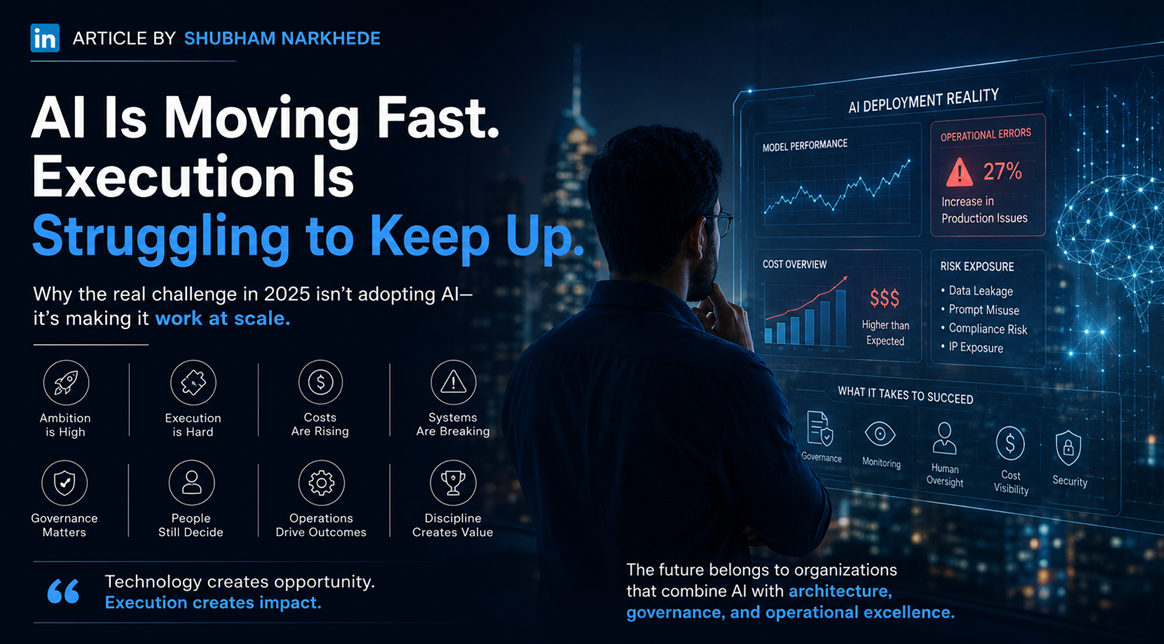
The gap between AI ambition and operational readiness is showing up as real damage.

Companies are deploying models faster than they can govern them. Employees are using AI tools faster than leadership teams can approve them. And the numbers reflect this clearly.

Only about one in four AI initiatives actually deliver their expected ROI. Fewer than 20 percent have been fully scaled across the enterprise. Nearly half of organizations using generative AI have already run into problems, ranging from hallucinated outputs to cybersecurity incidents, privacy exposure, and IP leakage.

The biggest misconception in the AI race is simple: intelligence does not automatically equal reliability.

A model generating impressive outputs in a sandbox does not mean it will operate reliably inside a real business system. Real enterprise environments are not controlled demos. They are messy, unpredictable, and full of edge cases that no demo ever reveals.

Real businesses operate through:

  • Legacy infrastructure that was never designed with AI in mind
  • Fragmented workflows across disconnected teams and systems
  • Compliance requirements that vary by region, industry, and contract
  • Unpredictable human behavior that no simulation accounts for
  • Inconsistent data pipelines feeding inaccurate information into models
  • Operational exceptions that break automation logic daily
  • Security vulnerabilities introduced the moment AI touches production systems
  • Constantly changing business rules that models have no awareness of

The real-world failures are not theoretical. They are already happening.

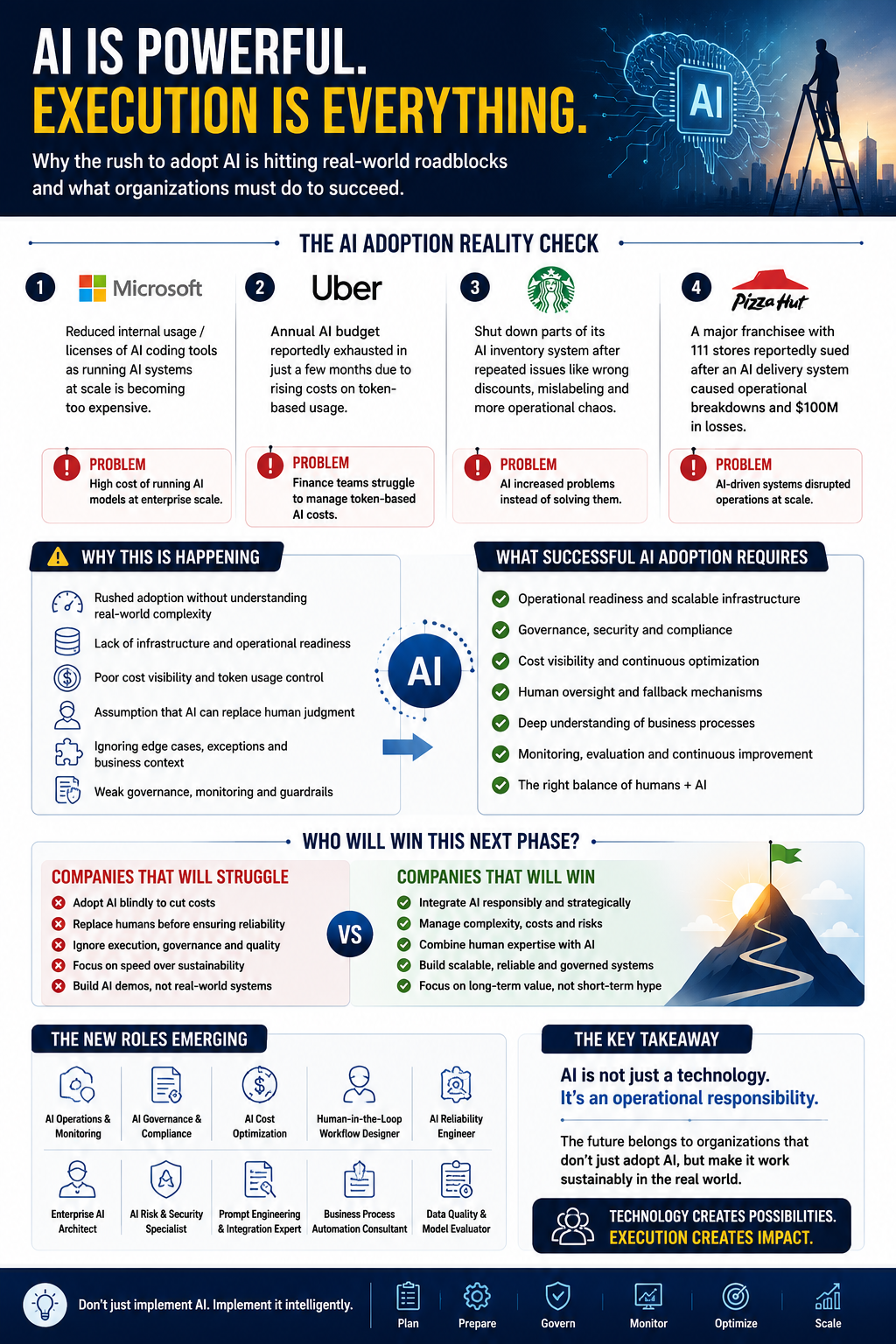
Finance teams did not anticipate how token-based pricing scales compared to traditional SaaS software costs. The more employees interact with models, the more workflows become AI-dependent, the more automation layers get added, and the harder cost visibility becomes. What looked affordable during pilot testing became a financial operations problem at enterprise scale.

Retail and logistics companies deployed AI-powered automation systems and ran into operational failures they never saw coming: incorrect discounts, inventory mismatches, mislabeling issues, broken fulfillment logic, and workflow conflicts between automated systems and human operations.

Logistics optimization engines performed perfectly in simulations. Then they failed when exposed to unpredictable delivery behavior, regional constraints, human delays, weather conditions, and real-world variables that no simulation modeled accurately.

And even the largest, most well-resourced companies in the world faced this. Walmart, mid-2025, had to completely reshape its agentic AI approach, moving away from multiple disconnected single-purpose agents toward a unified framework, because orchestrating dozens of agents created more operational fragmentation than efficiency.

The issue was never whether the model was intelligent. The issue was whether the surrounding system was mature enough to support it.
Understanding the Operational Need of AI in Industry

Sustainable AI adoption requires far more than plugging a model into your organization.

It requires:

  • Operational readiness established before deployment, not after
  • Governance frameworks that match your actual risk profile
  • Monitoring systems that catch failures before customers do
  • Infrastructure built for scale, not for pilots
  • Cost visibility so finance teams are not blindsided mid-quarter
  • Human oversight at every decision point that carries real consequence
  • Fallback mechanisms for when the model gets it wrong
  • Security controls that cover your actual exposure surface, not a theoretical one
  • Deep understanding of your specific business processes and where AI breaks them

This work is not glamorous. It does not generate viral demos or impressive press releases. But it is the difference between experimentation and sustainable adoption.

The internal risk conversation is still massively underestimated.

The riskiest AI behaviors in 2025 are not external threats. They are internal.

Employees are already uploading sensitive files into public AI tools. Teams are using unauthorized AI applications that sit entirely outside governance policies. Confidential prompts are leaking intellectual property. AI-generated outputs are introducing hallucinated information into real business workflows.

Most of this is not malicious. It is employees trying to work faster and stay productive. But speed without governance creates exposure. And many organizations were completely unprepared for how fast shadow AI usage would spread internally once employees realized how powerful these tools could be.

Between 2023 and 2024, the amount of corporate data being uploaded into AI tools rose by 485 percent. From 2024 to 2025, employee data flowing into generative AI services grew more than 30 times. That is not a slow, manageable shift. That is an exposure surface expanding faster than most security teams can track.

The conversation in the industry is shifting. And it is shifting in an important direction.

Not from "AI will replace everyone" to "AI is failing."

It is shifting from "How fast can we adopt AI?" to "How do we make AI work reliably at scale?"

That shift is already creating entirely new categories of technical work that barely existed two years ago:

  • AI operations and monitoring
  • AI governance and compliance
  • AI reliability engineering
  • AI cost optimization
  • AI security and auditing
  • Enterprise AI architecture
  • Human-in-the-loop workflow design
  • AI infrastructure optimization
  • Business-process-aware automation consulting

Ironically, while most people debate whether AI will eliminate jobs, AI is simultaneously creating entirely new technical disciplines. The market is not simply replacing expertise. It is redefining where expertise matters most.

Preparation beats speed. Every time.

The UAE invested in AI infrastructure and governance starting in 2017, five years before generative AI entered the mainstream. By 2025, AI trust there registered around 67 percent, compared to 32 percent in the US. That gap did not come from better models. It came from better preparation and longer institutional commitment to getting the foundations right before scaling fast.

I work at the intersection of full-stack engineering, DevOps, and system architecture. From this position, one thing is clear.

The organizations that will come out ahead are not the ones moving fastest. They are the ones combining technical execution with operational discipline. They are treating AI the way experienced engineers treat infrastructure: with monitoring, fallback mechanisms, governance layers, observability, and deep integration into actual business context.

The Three Waves of AI

The first wave of AI was about possibility.

The second wave is about sustainability.

The third wave will be about operational maturity.

The winners will not be the companies with the loudest AI announcements or the fastest deployment timelines.

They will be the companies with the strongest execution.

Speed gets you to production. Discipline keeps you there.

From Monoliths to Microservices: Automating Enterprise Architecture at Scale

· 8 min read
Shubham Narkhede
DevOps Engineer @ Robert Bosch GmbH

The Architecture Challenge

When I joined Bosch in 2022, the company was in the midst of a massive digital transformation. Legacy systems built over decades—some still running on COBOL and mainframes—needed to coexist with modern cloud-native applications. The challenge wasn't just technical; it was organizational and cultural.

Over the past two years, I've been part of the team that's been automating and orchestrating this transition. We've containerized 45+ microservices, standardized deployment pipelines, and built infrastructure that enables teams to ship code faster and more reliably. This is the story of how we did it.

The Starting Point: Chaos and Silos

In 2022, Bosch's IT landscape was fragmented. Different business units used different technology stacks. Some teams deployed to on-premises data centers; others used AWS or Azure. Deployment processes varied wildly—some teams had sophisticated CI/CD pipelines, others deployed manually via FTP.

This fragmentation created several problems:

Knowledge Silos: When each team had its own deployment process, knowledge about how to deploy and operate systems was scattered. If a key engineer left, the team lost critical institutional knowledge.

Inconsistency: Different teams had different standards for logging, monitoring, and security. This made it difficult to troubleshoot issues across systems.

Inefficiency: Deployment processes that could be standardized were instead reinvented by each team. This wasted engineering effort and introduced bugs.

Risk: Without standardization, it was difficult to enforce security policies or ensure compliance.

The Vision: Standardization and Automation

The leadership team at Bosch recognized this challenge and committed to a transformation. The vision was clear: standardize on a modern technology stack, automate deployment processes, and empower teams to move faster.

The strategy had three components:

First: Containerization. All applications would be containerized using Docker. This provided a standard unit of deployment and made it easier to move applications between environments.

Second: Orchestration. All containerized applications would be orchestrated using Kubernetes. This provided a standard platform for deployment, scaling, and management.

Third: Automation. All deployment processes would be automated using CI/CD pipelines. This eliminated manual steps and reduced the risk of human error.

The Implementation: A Three-Year Journey

Implementing this vision required significant effort. We didn't do a big-bang migration. Instead, we took a phased approach:

Phase 1 (2022-2023): Foundation

We started by building the infrastructure. We set up Kubernetes clusters in multiple cloud providers and on-premises data centers. We built CI/CD pipelines using GitHub Actions and custom automation. We established standards for logging (ELK stack), monitoring (Prometheus and Grafana), and security (HashiCorp Vault).

This phase was about creating the plumbing—the infrastructure that would enable teams to deploy applications reliably.

Phase 2 (2023-2024): Migration

Once the infrastructure was in place, we began migrating applications. We prioritized applications based on several criteria: business criticality, technical complexity, and team readiness.

The migration process for each application followed a standard pattern:

  1. Assessment: Understand the application's architecture, dependencies, and operational requirements.
  2. Containerization: Create Docker images for the application and its dependencies.
  3. Testing: Test the containerized application in a staging environment.
  4. Deployment: Deploy the application to Kubernetes.
  5. Monitoring: Set up monitoring and alerting for the application.
  6. Optimization: Optimize resource usage, performance, and cost.

This process wasn't always smooth. Some applications had dependencies that were difficult to containerize. Some teams were resistant to change. Some deployments had unexpected issues.

But we persisted. By the end of 2024, we had containerized and migrated 45+ microservices. The remaining applications are either legacy systems that will be retired or specialized applications that don't fit the standard model.

Phase 3 (2024-Present): Optimization and Automation

With the bulk of applications migrated, we've shifted focus to optimization and automation. We've implemented:

Auto-scaling: Kubernetes automatically scales applications based on demand. During peak load, the system spins up additional instances. During low-load periods, it scales down to save costs.

Self-healing: If a container crashes, Kubernetes automatically restarts it. If a node fails, Kubernetes reschedules the workload to a healthy node.

Canary Deployments: Instead of deploying a new version of an application to all instances at once, we deploy to a small percentage of instances first. If there are no issues, we gradually roll out to the rest.

GitOps: All infrastructure and application configurations are stored in Git. Changes to Git automatically trigger deployments. This provides a clear audit trail and makes it easy to roll back changes.

The Technical Architecture

Let me walk through the technical architecture we've built:

Application Layer: Applications are containerized using Docker. Each application has a Dockerfile that specifies the base image, dependencies, and configuration.

Orchestration Layer: Applications run on Kubernetes clusters. We've deployed clusters in multiple cloud providers (AWS, Azure) and on-premises data centers. A service mesh (Istio) provides advanced networking capabilities like traffic management, security policies, and observability.

CI/CD Layer: Code changes trigger automated builds, tests, and deployments. We use GitHub for version control, GitHub Actions for CI/CD, and ArgoCD for GitOps-based deployments.

Data Layer: Applications store data in managed databases (AWS RDS, Azure Cosmos DB) or self-managed databases running in Kubernetes. We've standardized on PostgreSQL for relational data and MongoDB for document data.

Observability Layer: We collect logs, metrics, and traces from all applications. Logs go to the ELK stack (Elasticsearch, Logstash, Kibana). Metrics go to Prometheus, which is scraped by Grafana for visualization. Traces go to Jaeger for distributed tracing.

Security Layer: We use HashiCorp Vault for secret management. Network policies in Kubernetes restrict traffic between applications. We've implemented RBAC (Role-Based Access Control) to ensure that teams can only access the resources they need.

The Automation Wins

The automation we've implemented has delivered significant benefits:

Deployment Time: Before automation, deploying a new version of an application could take hours or even days. Now, it takes minutes. A developer pushes code to Git, and the system automatically builds, tests, and deploys the application.

Reliability: Automated deployments are more reliable than manual deployments. We've reduced deployment-related incidents by 70%.

Scalability: Applications can now scale automatically based on demand. This means we can handle traffic spikes without manual intervention.

Cost Optimization: Auto-scaling and efficient resource utilization have reduced infrastructure costs by 25-30%.

Team Velocity: Teams can now deploy multiple times per day. This enables rapid iteration and faster time-to-market for new features.

The Challenges We Faced

The transformation wasn't without challenges:

Legacy System Integration: Some legacy systems couldn't be easily containerized. We had to build custom adapters and bridges to integrate them with the new infrastructure.

Data Migration: Moving data from legacy systems to modern databases was complex and risky. We had to ensure data consistency and zero downtime during migrations.

Organizational Change: Not all teams embraced the new infrastructure immediately. Some preferred the familiar manual processes. We had to invest in training and change management.

Operational Complexity: Running Kubernetes at scale introduces operational complexity. We had to hire and train engineers to manage the platform.

Cost Management: While automation has reduced costs overall, cloud infrastructure can be expensive if not managed carefully. We've had to implement cost controls and optimization strategies.

Lessons Learned

Looking back on this journey, several lessons stand out:

Start with a Clear Vision: The transformation succeeded because leadership had a clear vision and committed to it. Without this, the effort would have been fragmented and ineffective.

Take a Phased Approach: We didn't try to migrate everything at once. We took a phased approach, learning and adapting as we went.

Invest in Automation: Automation is not just about efficiency; it's about enabling teams to move faster and more reliably. The investment in automation has paid dividends.

Focus on Observability: You can't manage what you can't see. Investing in logging, monitoring, and tracing has been crucial for understanding and troubleshooting issues.

Prioritize Developer Experience: The infrastructure is ultimately for developers. If it's difficult to use, teams will resist it. We've invested in making the infrastructure easy to use through good documentation, tooling, and support.

The Impact on Business

The transformation has had significant business impact:

Faster Time-to-Market: Teams can now deploy new features and fixes faster, enabling the business to respond more quickly to market changes.

Improved Reliability: Automated deployments and self-healing infrastructure have reduced downtime and improved reliability.

Better Resource Utilization: Efficient resource allocation and auto-scaling have reduced infrastructure costs.

Improved Security: Standardized security practices and automated compliance checks have improved the security posture.

Happier Teams: Developers appreciate the ability to deploy code quickly and reliably. This has improved team morale and reduced turnover.

Looking Ahead

As we move into 2025, the focus will shift from migration to optimization and innovation. We'll be:

Implementing Advanced Observability: Moving beyond basic metrics and logs to advanced observability that includes distributed tracing, profiling, and anomaly detection.

Enhancing Security: Implementing zero-trust security models and advanced threat detection.

Optimizing Costs: Implementing FinOps practices to optimize cloud spending.

Enabling AI Workloads: Extending the platform to support AI/ML workloads, which have different requirements than traditional applications.


Key Takeaways

  • Standardization and automation are key to scaling infrastructure
  • A phased approach to migration reduces risk and allows for learning and adaptation
  • Investment in observability is crucial for managing complex systems
  • Developer experience should be a priority when building infrastructure
  • The business benefits of infrastructure transformation extend beyond cost savings to include speed, reliability, and security

In the next post, I'll explore how we're integrating AI workloads into our Kubernetes infrastructure and the unique challenges this presents.

AI at Bosch: The Silent Revolution in Enterprise Automation

· 8 min read
Shubham Narkhede
DevOps Engineer @ Robert Bosch GmbH

The Quiet Transformation

When people talk about AI in 2024, they think of ChatGPT, image generation, and large language models. But inside enterprise organizations like Bosch, the AI revolution is happening in a different form. It's quieter, less visible, but far more consequential: AI powering automation, optimization, and decision-making across thousands of business processes.

I've been observing this transformation firsthand. Over the past year, I've worked on infrastructure that enables AI-driven automation at scale. The shift isn't about replacing humans with robots—it's about augmenting human capability with intelligent systems that can process information, identify patterns, and execute decisions faster and more accurately than manual processes.

The Three Pillars of Enterprise AI at Bosch

First: Predictive Maintenance and Supply Chain Optimization

Bosch manufactures components for millions of vehicles globally. Supply chain disruptions—whether from geopolitical tensions, natural disasters, or market volatility—can cost millions. In 2024, Bosch has deployed AI models that predict component failures before they happen, optimize inventory levels in real-time, and recommend procurement strategies based on demand forecasting.

These aren't cutting-edge research projects. They're production systems handling billions of data points daily. The models are trained on historical manufacturing data, supplier performance metrics, and market signals. When a model predicts a potential shortage of a critical component, the system automatically triggers procurement workflows, notifies supply chain managers, and recommends alternative suppliers.

The impact is measurable: 15-20% reduction in supply chain disruptions, 10-12% improvement in inventory turnover, and significant cost savings. For a company like Bosch with global operations, this translates to hundreds of millions of euros annually.

Second: Intelligent Workflow Automation

Bosch is a company of processes. Thousands of workflows govern everything from hiring to invoicing to quality assurance. Many of these workflows are still partially manual, involving human review and approval at multiple stages.

In 2024, AI is automating these workflows. Document processing systems use optical character recognition (OCR) and natural language processing (NLP) to extract information from invoices, contracts, and technical specifications. Machine learning models classify documents, route them to appropriate departments, and flag anomalies for human review.

For example, the invoice processing workflow that previously required 3-4 manual touchpoints and 2-3 days to complete now processes 85% of invoices automatically within hours. The 15% that require manual intervention are those with unusual characteristics—discrepancies, missing information, or edge cases—which are flagged for human experts.

This isn't just about speed. It's about consistency, accuracy, and freeing human experts to focus on high-value work. The same engineers who previously spent 30% of their time on document processing can now focus on problem-solving and innovation.

Third: Intelligent Monitoring and Anomaly Detection

At Bosch, we operate complex manufacturing facilities, data centers, and IT infrastructure. Monitoring these systems traditionally requires large teams of engineers watching dashboards, responding to alerts, and investigating incidents.

In 2024, AI-powered monitoring systems have transformed this. Machine learning models learn the normal behavior of systems—CPU usage patterns, network traffic, database query performance—and flag deviations that might indicate problems. These systems don't just alert on thresholds; they understand context.

For instance, a spike in database queries at 2 AM might be normal if it's scheduled batch processing, but anomalous if it's occurring outside the expected window. AI models learn these patterns and only alert when there's a genuine anomaly. This reduces false positives by 70-80%, allowing engineers to focus on real issues.

The Technology Stack

What technologies power this transformation? The stack is more pragmatic than cutting-edge:

Machine Learning Frameworks: TensorFlow and PyTorch for model development and training. These frameworks have matured significantly, with extensive documentation and community support.

Data Pipelines: Apache Spark and Kafka for processing massive volumes of data in real-time. At Bosch, we're processing terabytes of data daily—manufacturing sensor data, transaction logs, supply chain metrics.

Model Serving: Kubernetes for orchestrating model inference at scale. A model that's accurate in development is useless if it can't serve predictions in production. Kubernetes enables us to deploy models, scale them based on demand, and ensure high availability.

Monitoring and Observability: Prometheus, Grafana, and ELK stack for monitoring model performance, data drift, and system health. This is critical—a model that performs well initially can degrade over time as data distributions change.

Integration: Custom APIs and middleware to integrate AI systems with existing enterprise applications. Most of Bosch's critical systems were built over decades. AI doesn't replace these systems; it augments them.

The Human Element

Here's what often gets overlooked in discussions of enterprise AI: the human element is crucial. At Bosch, we have data scientists building models, but we also have domain experts—supply chain specialists, manufacturing engineers, quality assurance professionals—who understand the business context.

The most successful AI implementations at Bosch are those where data scientists and domain experts collaborate closely. The data scientist might build a model that predicts component failures with 92% accuracy, but the domain expert understands that in manufacturing, false positives are more costly than false negatives. This insight shapes how the model is deployed and how its predictions are acted upon.

We've also learned that AI systems need human oversight. A model might recommend a procurement strategy that's technically optimal but politically unfeasible or ethically problematic. Humans need to be in the loop, especially for high-stakes decisions.

Challenges and Lessons Learned

The AI transformation at Bosch hasn't been frictionless. We've encountered several challenges:

Data Quality: Many of Bosch's legacy systems have data quality issues—missing values, inconsistent formats, outdated records. Before you can train an AI model, you need to clean and standardize the data. This is unglamorous work, but it's essential.

Change Management: Introducing AI systems means changing how people work. A supply chain manager who previously made procurement decisions based on experience and intuition now needs to work with AI recommendations. This requires training, communication, and patience.

Model Drift: A model trained on 2023 data might not perform well in 2024 if market conditions have changed. We've learned to continuously monitor model performance and retrain models as new data becomes available.

Regulatory and Ethical Concerns: As AI systems make decisions that affect people—hiring, resource allocation, vendor selection—there are regulatory and ethical considerations. Bosch has established governance frameworks to ensure AI systems are transparent, fair, and accountable.

The Business Impact

What's the bottom line? In 2024, AI-driven automation at Bosch is delivering measurable business value:

Operational Efficiency: 20-30% reduction in manual processing time across key workflows. This translates to cost savings and faster decision-making.

Quality Improvement: Anomaly detection systems catch manufacturing defects earlier, reducing rework and warranty costs.

Supply Chain Resilience: Predictive models enable proactive responses to supply chain disruptions, reducing downtime and lost revenue.

Employee Satisfaction: By automating routine tasks, employees can focus on more meaningful work. This improves job satisfaction and reduces turnover.

Competitive Advantage: In a contracting market, companies that can operate more efficiently have a significant advantage. AI-driven automation is a key lever for this efficiency.

Looking Forward

As I look toward 2025 and beyond, I see several trends:

Generative AI Integration: Large language models will be integrated into enterprise systems for document analysis, customer service, and knowledge management. Bosch is already experimenting with LLMs for technical documentation and customer support.

Edge AI: As IoT devices proliferate, there's a shift toward running AI models on edge devices rather than centralized data centers. This enables real-time decision-making and reduces latency.

Autonomous Systems: AI will enable more autonomous systems—manufacturing robots that can adapt to changing conditions, supply chain systems that can self-optimize, IT infrastructure that can self-heal.

AI Governance: As AI systems become more prevalent, governance frameworks will become more sophisticated. Regulatory requirements around transparency, fairness, and accountability will drive how AI is developed and deployed.

A Personal Perspective

Working on AI infrastructure at Bosch has been fascinating. It's easy to get caught up in the hype around AI, but the reality is more nuanced. AI is a tool—a powerful one, but still a tool. The real value comes from understanding the business problem, designing systems thoughtfully, and ensuring that AI augments human capability rather than replacing it.

The automotive industry is in transition. Companies like Bosch are using AI and automation to navigate this transition more effectively. The enterprises that master this will emerge stronger. Those that don't will struggle.


Key Takeaways

  • Enterprise AI at Bosch focuses on automation, optimization, and decision-making rather than cutting-edge research
  • Predictive maintenance, intelligent workflows, and anomaly detection are delivering measurable business value
  • The technology stack is pragmatic, leveraging mature frameworks and tools
  • Human expertise and oversight remain crucial for successful AI implementations
  • Data quality, change management, and model governance are critical challenges
  • AI-driven automation is a key competitive advantage in a contracting market

Next month, I'll dive deeper into the technical architecture of AI systems at scale, exploring how we handle data pipelines, model serving, and monitoring in production environments.

Reflecting on 5 Years in Tech: Lessons Learned and Future Directions

· 5 min read
Shubham Narkhede
DevOps Engineer @ Robert Bosch GmbH

As I mark five years since beginning my professional journey in software development, I find myself in a reflective mood. Looking back at my path from a fresh graduate to my current role as a DevOps Engineer at Robert Bosch GmbH, I'm amazed at how much has changed—both in the technology landscape and in my own approach to software development.

The Journey So Far

My career began in 2018 with enthusiasm and a foundation in computer science fundamentals. Since then, I've had the privilege of working at companies like Amazon, Bosch Rexroth, and now Robert Bosch GmbH. Each role has presented unique challenges and learning opportunities that have shaped my technical skills and professional outlook.

What strikes me most is how my perspective has evolved. When I started, I was primarily focused on mastering specific technologies and languages. While technical proficiency remains important, I've come to appreciate that software development is as much about people, processes, and problem-solving as it is about code.

Key Lessons from 5 Years in Tech

1. Communication Trumps Code

Perhaps the most significant lesson I've learned is that exceptional communication skills are more valuable than exceptional coding skills. The ability to clearly articulate technical concepts to non-technical stakeholders, negotiate requirements, and collaborate effectively with team members has proven invaluable throughout my career.

I've seen brilliant technical solutions fail because they weren't properly communicated or aligned with business needs. Conversely, I've seen relatively simple technical approaches succeed wildly because they were well-communicated and addressed the right problems.

2. Adaptability is Essential

The pace of change in technology is relentless. Languages, frameworks, and tools that were cutting-edge when I started are now considered outdated or have evolved significantly. What has served me well is not mastery of specific technologies but the ability to adapt and learn quickly.

This adaptability extends beyond technical skills to encompass changing project requirements, team dynamics, and organizational priorities. The most successful professionals I've encountered are those who embrace change rather than resist it.

3. Systems Thinking Matters

As I've progressed from writing individual components to designing and implementing entire systems, I've come to appreciate the importance of systems thinking. Understanding how different parts interact, identifying potential bottlenecks, and anticipating failure modes are critical skills for creating robust solutions.

This perspective has been particularly valuable in my DevOps role, where I need to consider the entire software lifecycle from development to deployment and monitoring.

4. Technical Debt is Real

Early in my career, I underestimated the impact of technical debt. Taking shortcuts or implementing quick fixes seemed harmless in the moment, but I've since witnessed how accumulated technical debt can paralyze development teams and erode system reliability.

I've learned to advocate for addressing technical debt proactively and to communicate its business impact effectively to stakeholders who might otherwise prioritize new features exclusively.

5. Work-Life Balance Enables Sustained Performance

Perhaps counterintuitively, I've found that maintaining a healthy work-life balance has made me more effective professionally, not less. Burnout is a real risk in technology careers, and I've seen talented colleagues struggle when they neglect their wellbeing.

Regular exercise, hobbies outside of technology, and quality time with family and friends have helped me maintain perspective and creativity in my work.

Looking to the Future

As I look ahead to the next phase of my career, several areas excite me:

Cloud-Native Development

The shift toward cloud-native architectures, containerization, and microservices continues to transform how we build and deploy software. I'm particularly interested in how these approaches can improve scalability and resilience while enabling faster delivery of value to users.

AI and Machine Learning Integration

The rapid advancement of AI and machine learning tools presents fascinating opportunities for enhancing software systems. I'm exploring how these technologies can be integrated into DevOps practices for predictive monitoring, automated testing, and intelligent deployment strategies.

Sustainable Technology

Working in the electric mobility space at Bosch has heightened my awareness of technology's environmental impact. I'm increasingly interested in how we can build more sustainable systems—both in terms of energy efficiency and responsible resource usage.

Leadership and Mentorship

As I continue to grow in my career, I find myself drawn to leadership and mentorship opportunities. Helping others navigate their technical careers and contributing to team culture and effectiveness is becoming as rewarding as solving technical challenges.

Conclusion

Five years into my technology career, I'm grateful for the experiences and lessons that have shaped my journey. The challenges have been as valuable as the successes, and I'm excited about the continued learning and growth that lie ahead.

The technology landscape will undoubtedly continue to evolve at a rapid pace, but I believe the fundamentals of effective problem-solving, clear communication, and continuous learning will remain constant. These are the foundations I'll continue to build upon as I move forward.

I'm curious to hear from others at similar points in their careers. What have been your most valuable lessons? How has your perspective on technology and professional development changed over time? Please share your thoughts in the comments!

Here's to the next five years of learning, growth, and creating technology that makes a positive difference in the world.

Exploring the Future of Artificial Intelligence

· 5 min read
Shubham Narkhede
DevOps Engineer @ Robert Bosch GmbH

Artificial Intelligence (AI) is not just a technological advancement; it's a revolutionary force reshaping industries, redefining jobs, and sparking ethical debates worldwide. As we enter a new era of intelligent machines, AI promises to enhance productivity and solve complex problems, but it also challenges us to consider its broader implications on society, ethics, and the workforce. In this post, we'll explore the impact of AI on key industries, address pressing ethical considerations, and offer some predictions for where AI might take us by 2025.